1841
1841
A Gallery is Born
Robert Vose was the first Vose family member to arrive in the Boston area from England. It was his grandson, Joseph Vose, who left the family homestead in 1833, settling in Providence, Rhode Island where he built a shoe factory. By the 1840s, Joseph Vose had done quite well for himself, but wanted out of the shoe business. He went on to purchase a small art supply store established in 1841 which dealt in artist’s supplies, prints, frames, and the occasional painting. According to records however, it was Joseph’s son Seth Morton Vose (1831-1910) who became more involved in the new business that his father had purchased. He joined the business at the spry age of 19 years old in 1850.
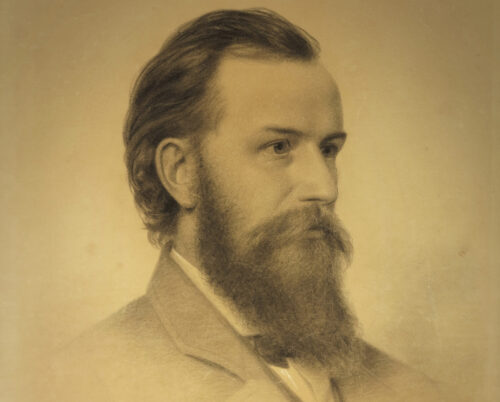
A young Seth Morton Vose as depicted by artist William Morris Hunt (1824-1879)
March 15, 1856
Westminster Art Gallery
1841-1860
From 1850 on, Seth Vose ran his gallery under the newly formed name of the “Westminster Art Gallery”. On March 15, 1856, Seth took on a new business partner, and together they moved up the street from 186 Westminster Street to 154 Westminster. This partnership did not last more than two years, splitting up in 1858.
February 6, 1860
Vose and Jenckes – A Partnership, Short-Lived
After another move of the gallery to 125-129 Broad Street in Providence, Seth Vose took on another new business partner in Mr. Henry C. Jenckes…
In what would prove yet again to be another failed partnership, Vose and Jenckes was formed. With the chaos of the Civil War in full swing, Jenckes was left to run the business on his own, while Seth Vose recovered from a medical issue. When Seth returned, he found that Jenckes had made some self-serving decisions to pay off his own depts, leaving the business in disrepair. He absconded thereafter leaving Seth Vose on his own again to pick up the pieces and rebuild his business.
However it wasn’t all bad. Pre-war articles available to us from 1860 shed light on just how much Seth Vose was promoting “works of genuine worth” of local Providence artists, such as Martin Johnson Heade, Thomas Robinson, George Owen, Jr., and many Hudson River School painters.
In Support of the Barbizon Rebels
Vose Galleries in the 1870s
Seth Vose almost dropped the paints and brushes he had been wrapping. His customer had come bursting out of the picture gallery at the back of the store shouting, “Those paintings in there, where did you get them?”
No doubt the man was American, but he was flinging his arms about like some Frenchman. He liked the pictures, though, so Seth’s deep voice took on a friendly note when he answered, “They are by artists who are working in a little village called Barbizon, not far from Paris, I think they are quite beautiful.”
“I know, I know,” the stranger sputtered. “I’ve lived there and painted beside Corot, Daubigny, Rousseau, all of them. Millet was my teacher.” And before Seth could back away, the visitor had seized him by the shoulders and kissed him on both cheeks.” Thus began Seth’s relationship with William Morris Hunt.*

April 1, 1861
Vose & Huxford
The successful, final partnership…
Seth Morton Vose went on to find his best and most successful partner in business yet in a man by the name of J.A. Huxford, who brought with him expert level experience in framing and woodworking which helped their business flourish. The alliance of Vose & Huxford lasted over eleven years, and included several moves during that period
1872
A Gallery on the Move
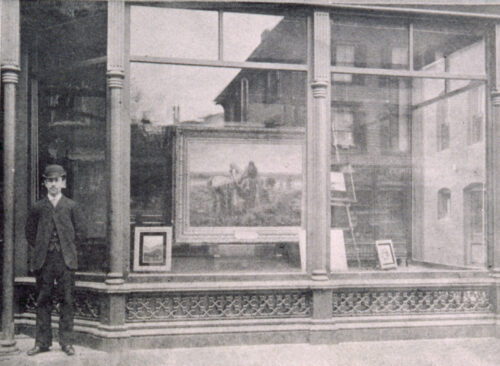
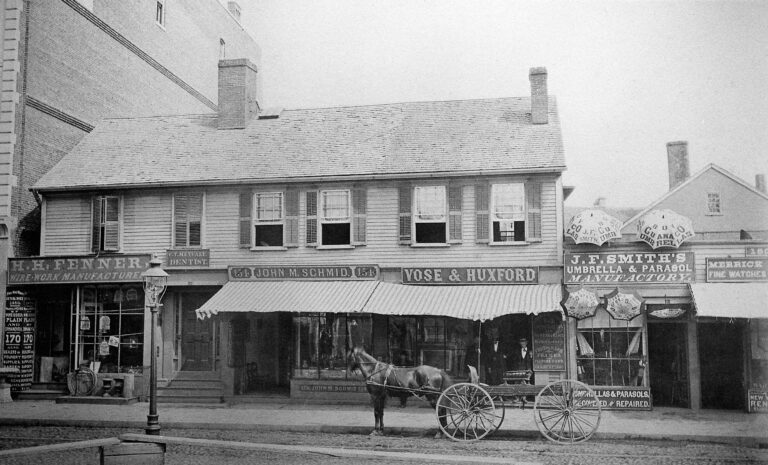
In 1872, Vose & Huxford moved to 176 Westminster Street in Providence (pictured above). There, it operated for 6 years before moving to 11 Westminster Street. With this move, they renamed the firm back to its original title of the ‘Westminster Art Gallery’. Seth moved the Westminster Art Gallery, yet again, in 1881 to 337-339 Westminster (pictured below). All these moves and changes reflect how difficult and what a challenge it must have been for him to operate a business at this time.
1881
The Move to Boston
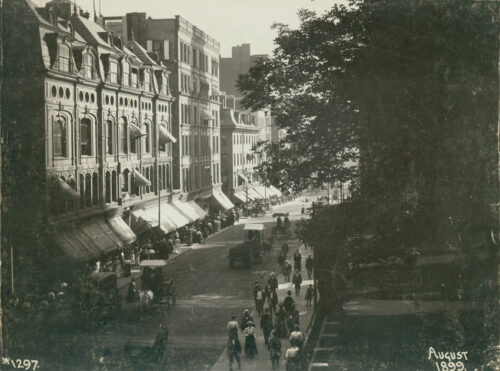
After a brief stint in a rented space on Washington Street near Bromfield, Seth found great success founding a new gallery space in the Studio Building at 110 Tremont street (on left in photo below from 1899). Here he opened rooms by appointment to accommodate his growing number of Bostonian clientele where he served the arts community for over 20 years. At the same time, he never left his roots in Providence, keeping the Westminster Art Gallery in operation during that time.
The Roaring 1880s
Seth Vose Finds Success
I liked his pictures from the first time I saw them, and as I had collected a number of them, I thought I would share my pleasure with my friends and townsmen so I hung them in my rooms and asked people to come and see them. Well they came but they laughed so at my pictures and made such fun of my taste that I took all the Corots down and put them away and did not show them again for a long while.
– Seth Morton Vose, interview with Clarence Cook in The Studio, April 1891.
The popularity of the French Barbizon School grew exponentially during the 1880s in an expanding art market that America would not experience again until the 1980s. During this affluent period, Seth Vose was finally rewarded for his efforts as curiosity emerged surrounding his inventory of Barbizon School paintings. His firm would import or advise the acquisition of nearly half of the pre-Impressionist French paintings in the collection of the Museum of Fine Arts, Boston.
The acceptance of the Barbizons by Boston’s elite excited a terrific competition for the acquisition of paintings by artists such as Corot, Daubigny, Millet, Rousseau and Delacroix. This competition occasionally turned uncomfortable, as in one incident in which Seth was discussing a painting in the gallery with a Boston collector. A second collector, who was typically known as a consummate gentleman, took charge of the situation by tossing his cape over the painting and claiming it for his own. The first client rose, said goodbye to Seth, and left quietly. It would take one hundred years for the art market to reach another such dramatic decade.
The Debut of R. C. Vose
1897
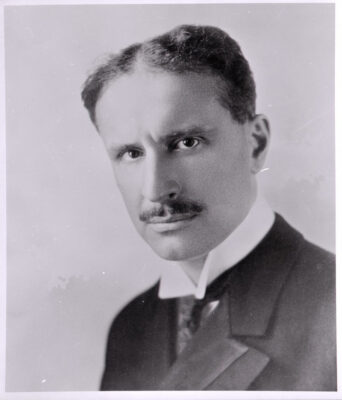 Like his father Seth, Robert C. Vose (1873-1964) possessed the energy and entrepreneurial spirit necessary to run a successful business. During the next sixty-seven years, Robert was to steer the once provincial gallery into a position of national prominence. Also like his father, Robert would be remembered as one of the greatest American art dealers of his era.
There was little doubt about what Robert would do with his life. At age ten he had a small desk in the corner of his father’s famous gallery in Providence, and the lure of the art world was soon to prove irresistible. After graduating from Brown University in 1896, he set sail for Europe, where he toured all of the great museums and galleries. Upon returning to Boston in 1897, the young enthusiast opened a gallery under his own name at 320 Boylston Street, and found immediate success in showing paintings by George Inness, William Bradford, George L. Brown, Alfred T. Bricher and William Trost Richards – artists who had also brought success to his father.
1900
1900-1910
The Turn of the Century
R. C. Vose’s early career paralleled Boston’s rise to the center of art in America at the turn of the century.
He worked to promote his growing family business by broadening the gallery’s horizons through the display of a fine stock of Barbizon, Dutch, English and American artists. Robert toured these exhibits throughout America while his younger brother, Nathaniel, and cousin, Charles Thompson, handled the busy Boston gallery with a new show every three weeks.
Robert took his first exhibit across the country to Oregon for the Lewis and Clark Exhibition of 1905. Thereafter, he showed paintings by invitation in museums and in exclusive hotel shows. In the event of the latter, Robert would reserve a double suite in an agreeable hotel, clear the rooms of all furniture, and transform them into a gallery of over 100 paintings. As a result of his efforts, as well as a fine eye and aesthetic sense which Robert shared with his forefathers, Vose paintings now hang in almost every major American museum.
As for his personal taste, Robert considered Adolphe Monticelli (1824-1886) to be the greatest colorist and initiator of the Impressionist technique, while he viewed John Twachtman (1853-1902) as America’s greatest Impressionist. Robert often described his guiding philosophy in two lines from Keats’ “Ode on a Grecian Urn:” Beauty is truth, truth beauty, and that is all ye know on earth, and all ye need to know!
1910-1920
The End of an Era
The death of Seth M. Vose in April of 1910 marked a period of great change for Vose Galleries.
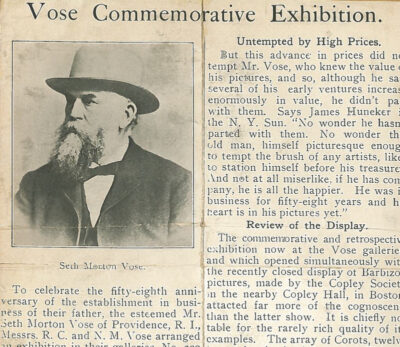 Robert Vose closed the original Providence storefront and gradually began to distinguish his tastes from those of his father. Although Robert would maintain the tradition established by Seth in the collection and display of Barbizon paintings, a 1909 exhibition at the Alaska Yukon Pacific Exposition in Seattle would signify a transition towards an emphasis on 18th-century English portraiture and 19th century Dutch paintings. Robert also began displaying works by American artists who were lesser known in Boston, including William Anderson Coffin (1855-1925), Edwin Lord Weeks (1849-1903), Mary Macomber (1861-1916), and Charles Gruppe (1860-1940).
1914
Evading Trouble | Traveling Exhibitions
The 1910s brought some controversy to the success of Robert’s travelling exhibitions.
1920
Vose Galleries in Back Bay
After a big move to Boylston Street in 1897, it seemed Back Bay was the most suitable home for a bustling successful fine art gallery. R.C. Vose & his brother Nathaniel Morton Vose would end up moving the gallery to 4 different locations on Boylston Street between the years of 1897 and 1924.
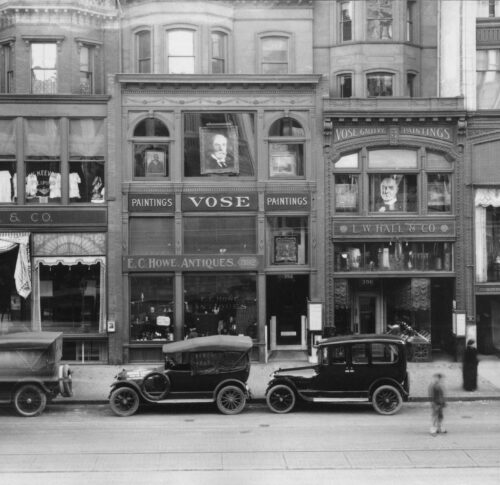 394 and 398 Boylston Street, c. 1915
May 31, 1924
In the Heart of Copley Square
News Clipping from The Art News, Vol. 22, no. 34
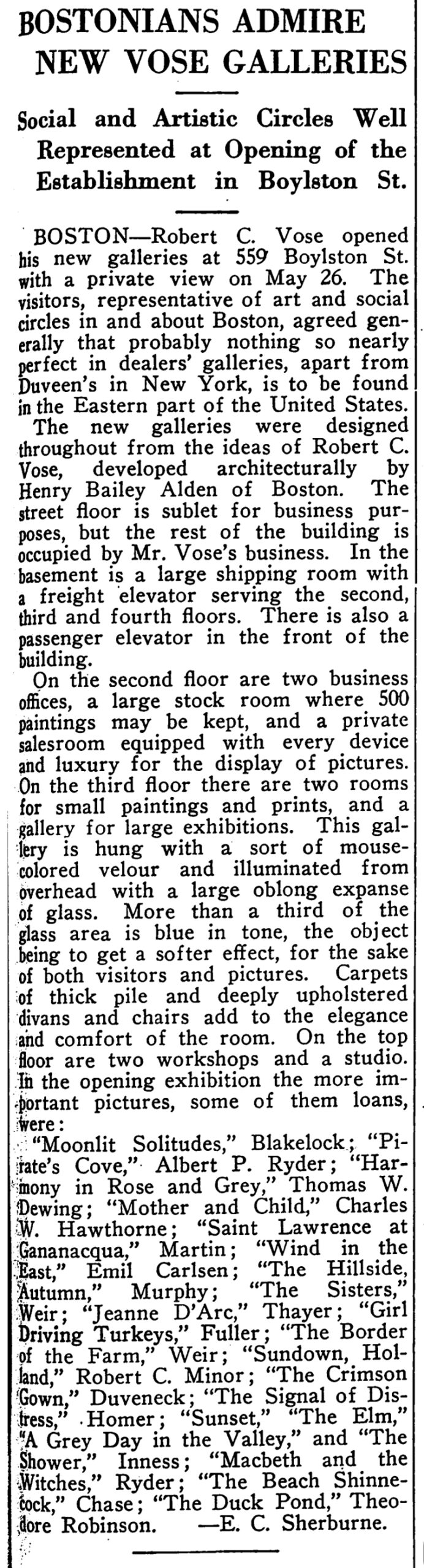
Back Bay truly did prove to be a proper home for the gallery. After this move in May of 1924, the ‘Robert C. Vose Galleries’ would go on to successfully deal art in the heart of Copley Square for over 40 years.
1930
The Great Depression
The prosperity of the 1920s came to an abrupt end as the Depression hit in 1929. By 1931, Robert C. Vose’s eldest son, Seth Morton Vose II, joined his father in business after graduating from Harvard College, followed by his brother Robert C. Vose, Jr., who left the Harvard Class of 1934 to join the firm in 1932. During these lean years, the brothers lived at home, and American paintings could be bought for pennies on the dollar. Having barely survived this difficult time, S.M. Vose II and Robert Vose, Jr. decided to concentrate almost exclusively on antique American art and during their tenure helped build prominent private and public collections during a time of rising interest in America’s art heritage.
1962
Newbury Street
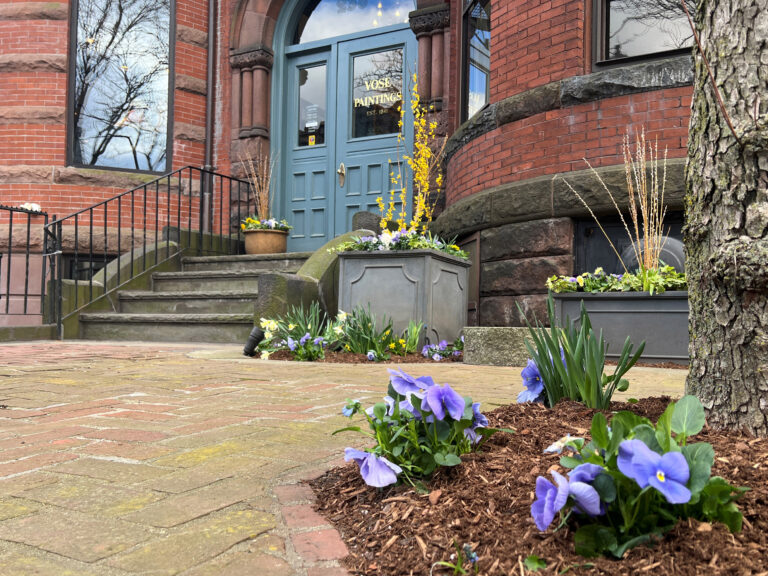
Our latest move to our current location, on Boston’s historic commercial street.
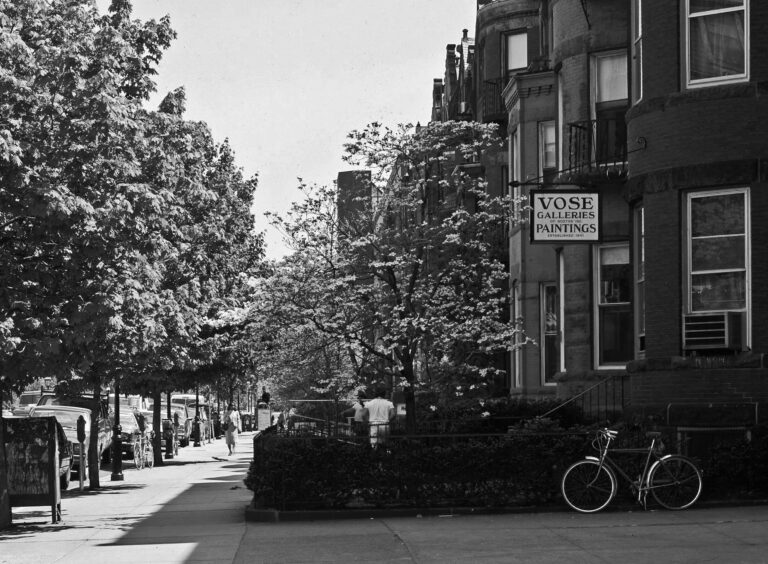
In 1962, Robert Vose, Jr. moved the business to the present 238 Newbury Street location. After their father died in 1964, the brothers counted themselves among the country’s leading authorities in American art history and its painters, spanning the years 1660-1940.
1969
The 70s
5th generation Vose brothers at the helm…
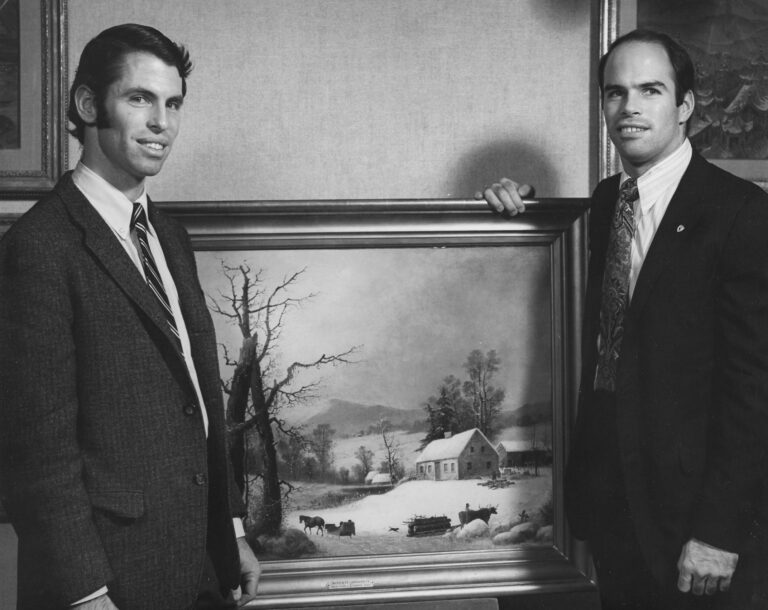
Robert’s twin sons, Abbot W. Vose (Bill) and Robert C. Vose III (Terry) joined the firm in 1969 and 1970, respectively. While both brothers remained generalists in the field, Bill Vose traveled the country, like his grandfather, giving dozens of lectures promoting the newly rediscovered American Impressionists.
1980s – 1990s
The Decades of Decadence
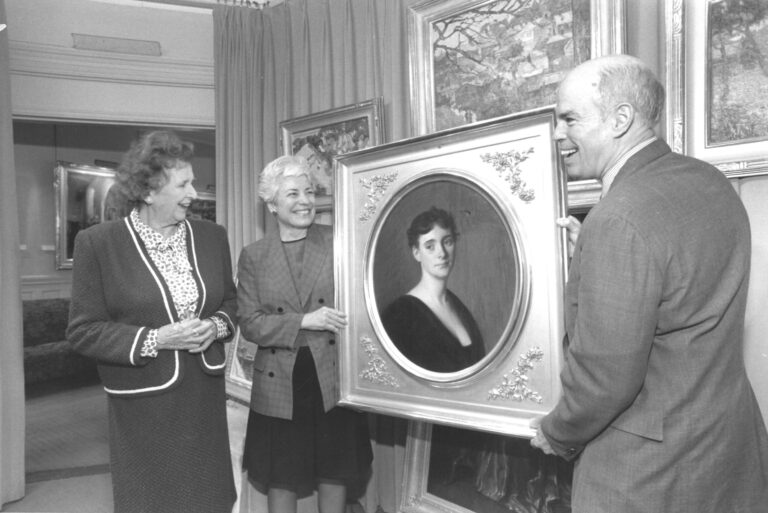
In 1972, Bill married Marcia Latimore and by 1984 she joined her husband and in-laws at the bustling art firm. The 1980s brought with it a booming economy, and thus a more commercialized art market flourished. For over 30 years, Marcia and Bill led the gallery with great success into the 21st century together.
2000
2002
The Vose Sisters
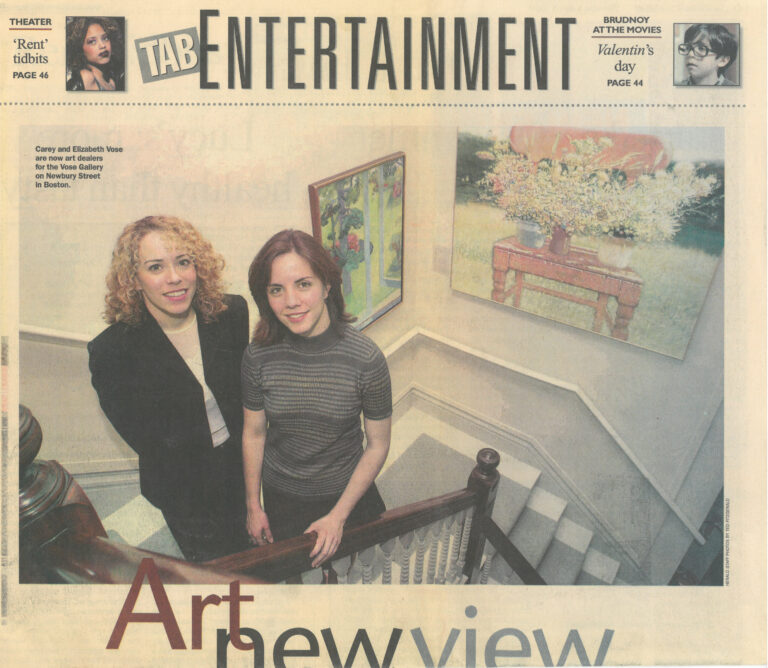
After working on and off part time for their parents and for other galleries, Carey Vose and her sister Beth joined the family business in 2002, bringing their newly founded expertise and young energy to the firm. This represented a brand new era for the family business, which had previously only passed its legacy from father to son since its founding.
2007-2009
The Great Recession
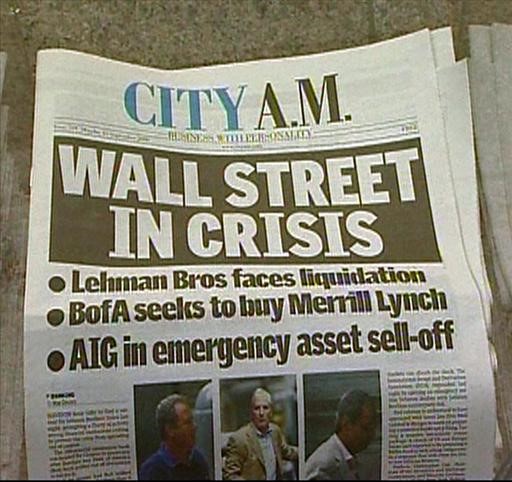
In the wake of the housing market collapse and the ensuing global financial crisis, the United States entered one of the most severe economic downturns in its history—an era now widely known as the Great Recession. Between December 2007 and June 2009, and continuing into 2010, approximately 1.8 million small businesses were forced to shut their doors. The art market was not immune to this turmoil, and like many industries, galleries were hit hard. Yet, having weathered both world wars and the Great Depression, there was reason to believe the gallery could endure once again. As the new millennium progressed into the 2010s, the art market began to recover swiftly, with collectors returning and acquisitions resuming—marking a renewed period of resilience and revival for Vose Galleries.
2020
A Global Pandemic
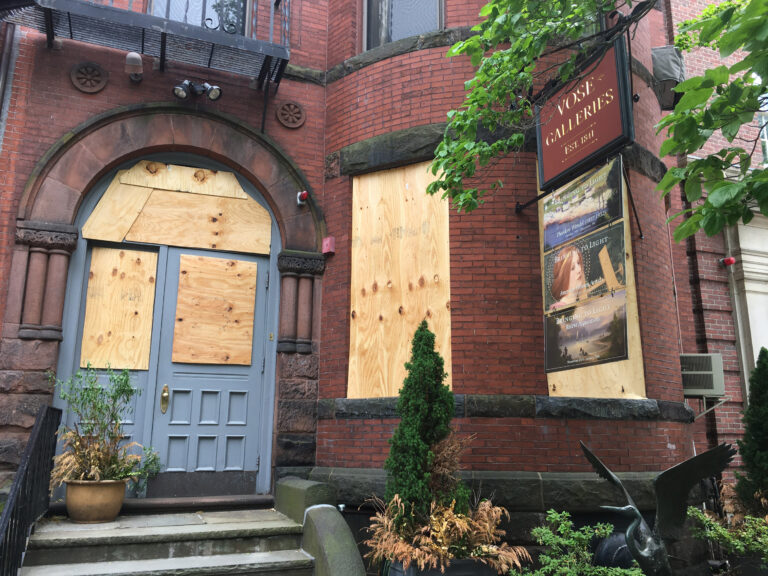
The year 2020 brought unprecedented challenges, beginning with the global outbreak of the COVID-19 pandemic. Lockdowns, health concerns, and economic uncertainty forced businesses across the country to close their doors temporarily—some indefinitely—as communities grappled with the rapidly changing landscape. Amid this public health crisis, the nation was further shaken by the murder of George Floyd, which sparked a powerful wave of protests demanding racial justice and police reform. In cities across the U.S., including Boston, demonstrations ranged from peaceful gatherings to instances of civil unrest. In response, many storefronts—regardless of their involvement or stance—boarded up their windows as a precaution against potential damage as some of our neighbors found themselves looted. Yet even in a time marked by fear and fragility, there were moments of resilience, solidarity, and hope. Businesses adapted, communities came together, and important conversations were brought to the forefront. For many, including the gallery, this period became a turning point—a chance to reflect, reimagine, and emerge stronger with a renewed commitment to purpose and perseverance.
2025
Looking Ahead
At the start of 2025, Carey Vose became the sole owner of Vose Galleries, marking a new chapter in a family legacy that has spanned over 180 years. As the sixth generation to lead the gallery, Carey brings both a deep reverence for its storied past and a clear, passionate vision for its future. Vose Galleries has remained steadfast in its commitment to excellence in American art, adapting thoughtfully to the changing needs of artists, collectors, and the broader cultural landscape. Under Carey’s leadership, the gallery continues to honor its traditions while embracing innovation, fostering meaningful relationships across generations. As we look toward the future, we do so with gratitude, resilience, and a renewed sense of purpose—hopeful that the Vose legacy will continue to thrive for generations to come.